
We already know that shoppers are influenced by in-store audio advertising. Decades of research have shown that sound affects mood, attention, pace, and ultimately purchasing decisions.
Still, it’s always valuable to get a fresh reminder – especially when it comes from real campaigns, real shoppers, and real point-of-sale data.
That’s exactly what we recently received from a two-month in-store audio advertising pilot with a large European grocery retailer.
The objective was simple: measure the incremental sales impact of in-store audio advertising in a live retail environment.
The results came directly from the retailer’s own POS system, and the findings were hard to ignore.
The test
Over a period of two months, the retailer ran 56 campaigns across multiple stores and product categories.
During the pilot:
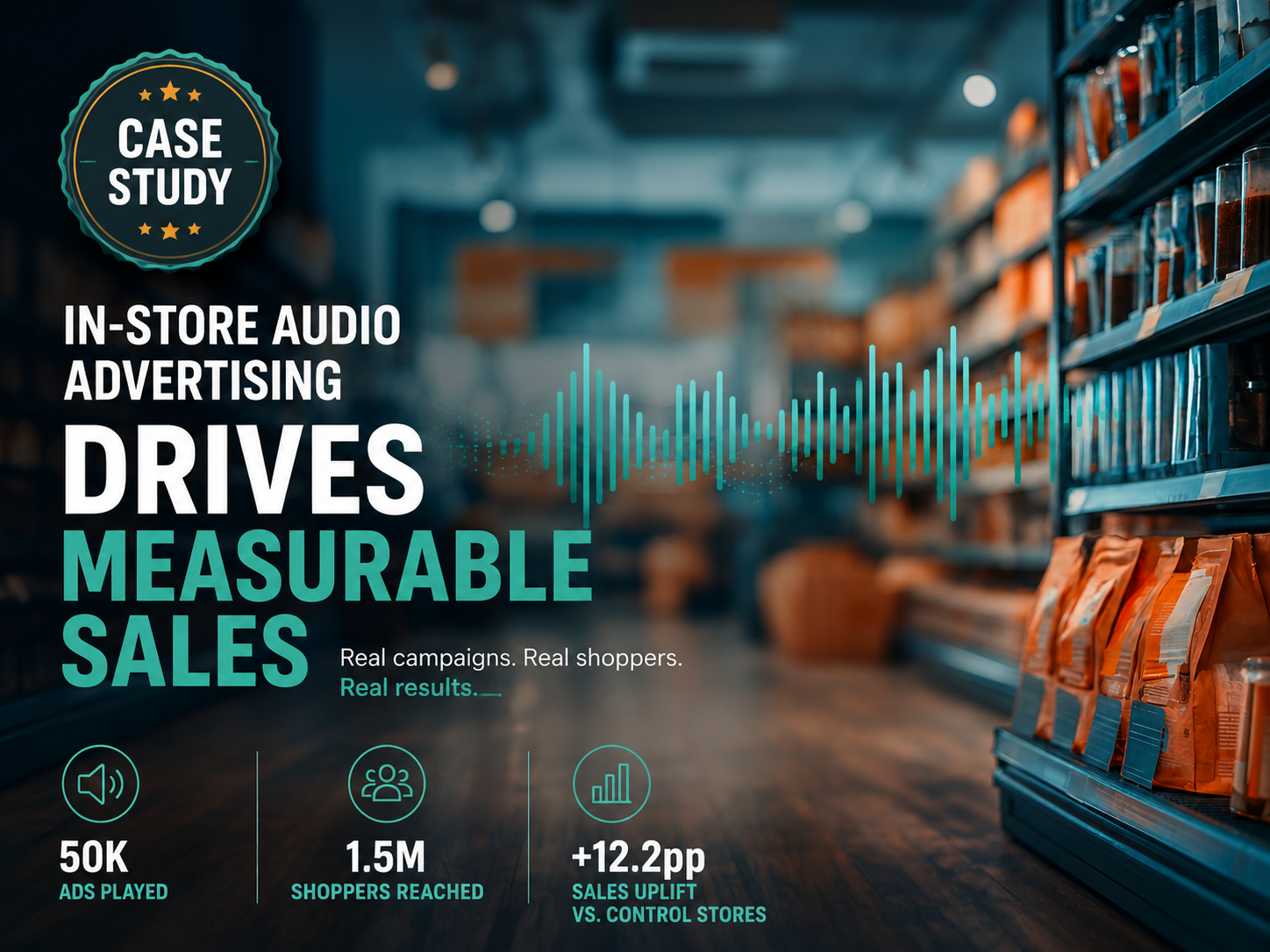
- More than 50,000 audio ads were played (for 56 campaigns).
- Ads were delivered at a rate of approximately 20 ads per hour.
- The campaigns reached an estimated 1.5 million shoppers.
- Categories included soft drinks, coffee, snacks and other high-volume grocery products.
To isolate the impact of audio, the retailer compared participating stores with a control group of similar stores that did not play the ads. The stores shared comparable characteristics including assortment, traffic levels, shelf placement, and promotional calendars.
The Results
Stores running in-store audio advertising achieved 29.3% year-over-year growth in the advertised pfoducts.
Comparable stores without audio advertising grew by 17.1% during the same period.
That translates into a 12.2 percentage point sales uplift attributable to in-store audio advertising.
Coffee: A Clear Example
One coffee campaign illustrated the impact particularly well.
During a 13-day campaign flight for a specific coffee brand:
- Stores with audio advertising experienced 54% year-over-year unit growth.
- Control stores grew by 30% over the same period.
The result was a 24 percentage point incremental uplift attributable to the audio campaign.
Measuring the True Impact
The analysis used a Difference-in-Differences (DiD) methodology, a statistical approach specifically designed to remove external factors that affect all stores equally.
This means the measurement accounts for:
- Seasonal demand changes
- Promotions running chain-wide
- Macro-economic effects
- Category trends
What remains is the incremental effect generated by the audio advertising itself.
Consistency Across Campaigns
The results were not driven by a single outlier.
Six of the eight highest-volume campaigns delivered positive Difference-in-Differences results, demonstrating that the impact was repeatable across products and categories.
The Takeaway
In-store audio is no longer just background music.
It is a measurable retail media channel capable of influencing shoppers at the exact moment purchase decisions are made – in front of the shelf, inside the store, and seconds before the transaction happens.
For retailers looking to unlock new retail media inventory and for brands looking to influence the last meter of the customer journey, in-store audio deserves a seat at the table.
