
Here are four of the most famous scientific experiments demonstrating how sound and music influence shopper behavior in stores. These are often cited in retail marketing and neuromarketing research.
1. Music Tempo Experiment (Supermarket Speed)
Study:
Ronald E. Milliman (1982)
Using Background Music to Affect the Behavior of Supermarket Shoppers
Journal of Marketing
Experiment
A supermarket alternated between:
- Slow music (~72 beats per minute)
- Fast music (~94 beats per minute)
Everything else in the store remained identical.
Results
- Slow music → shoppers moved slower
- Sales increased by about 38%
Why?
Customers spent more time walking and browsing, which increased the basket size.
Key insight
Tempo affects shopping pace, which directly affects revenue.
This is why many supermarkets deliberately use slow tempo background music.
2. Classical Music and Premium Spending (Wine Store)
Study:
Adrian North, David Hargreaves, Jennifer McKendrick (1999)
The Influence of In-Store Music on Wine Selections
Experiment
Researchers alternated:
- Classical music
- Top-40 pop music
Results
When classical music played:
- Customers bought more expensive wine
- Average spending increased significantly
Customers did not buy more bottles — they bought higher-priced ones.
Interpretation
Classical music creates a perception of sophistication and quality, which shifts consumer choices toward premium products.
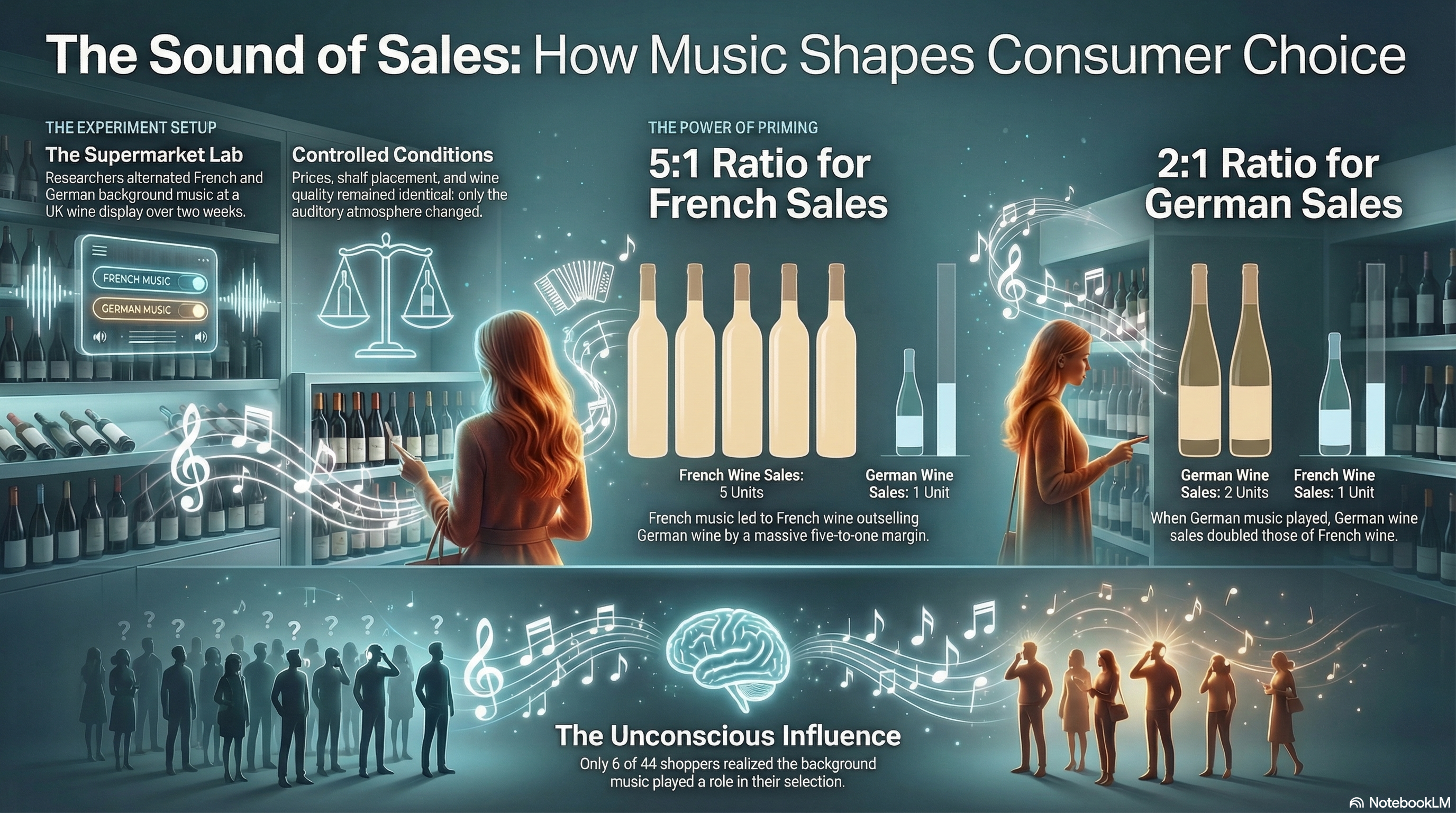
3. The French vs German Wine Study (Priming Effect)
Study:
North, Hargreaves & McKendrick (1997)
Published in Nature
Experiment
The store alternated music:
- French music
- German music
Results
| Music | Wine purchased |
|---|---|
| French music | French wine dominated |
| German music | German wine dominated |
When French music played: French wine outsold German wine 5:1
When German music played: German wine outsold French wine 2:1
Yet most shoppers said the music had no influence.
Key concept
Subconscious priming.
Audio activated country associations that guided purchase behavior.
4. Loud vs Quiet Music in Retail
Study:
Smith & Curnow (1966)
One of the earliest retail music experiments.
Experiment
Researchers tested:
- Loud music
- Soft music
Results
- Loud music → shoppers spent less time in store
- Quiet music → shoppers stayed longer
However:
- Spending per minute stayed similar
So louder music reduced total spending simply because customers left earlier.
These 5 studies prove three powerful effects of audio in stores:
| Effect | What changes |
|---|---|
| Tempo | shopping speed |
| Style | perceived product quality |
| Cultural cues | product choice |
| Volume | dwell time |
This is why audio is one of the most powerful sensory triggers in retail environments.
Unlike screens, shoppers cannot “look away” from sound.
About Jukee
With the help of AI, Jukee transforms store audio into a high-impact, programmatic, brand-safe, measurable media channel that influences choice in real time – without disrupting the shopping experience
